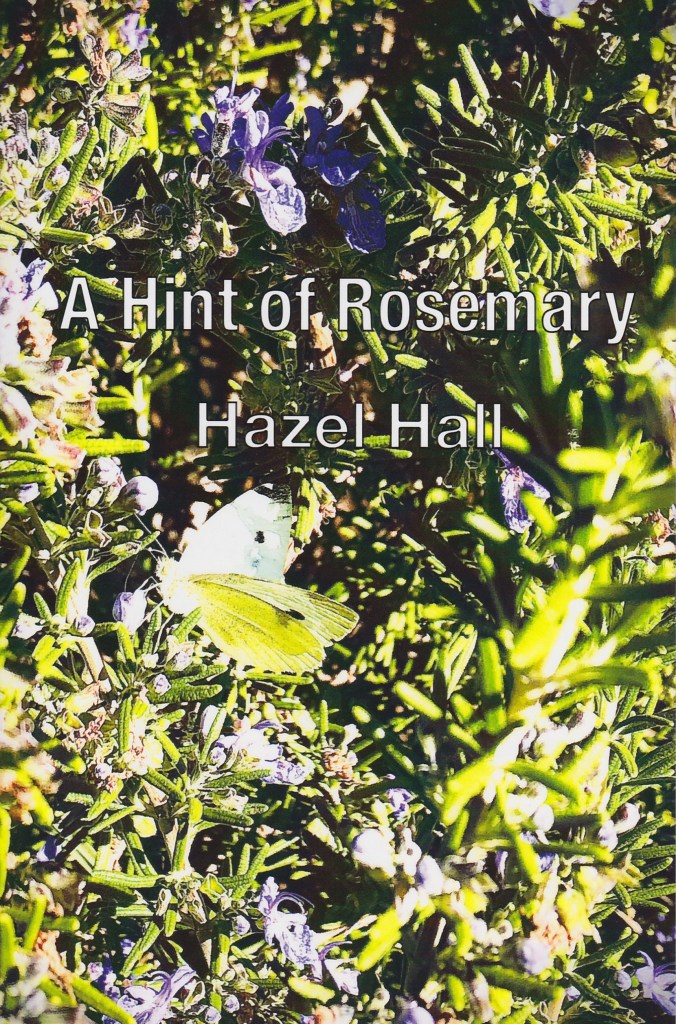
Canberra poet and musicologist, Hazel Hall, has published a collection of poems exploring the possibilities of the sonnet; from traditional forms to poems that may not be sonnets at all. Her book, titled A Hint of Rosemary, is published by Interactive Press.
Hazel says ‘I’ve always maintained that the spoken word is part of the vast spectrum we call song’. And the traditional sonnet, written in iambic pentameter, certainly brings a sense of musicality to a poem. Consider, for example, this closing couplet from Hazel’s poem, Sunday School Picnic, about a group of children visiting the beach:
to snatch the bliss of sinking with a sigh
in wallowing waves beneath the shrieking sky.
These are evocative lines of poetry but they could easily be lines from a song. While the structure of Hazel’s poems varies greatly, this sense of song is present throughout the collection.
The two best known forms of the traditional sonnet are the Italian, or Petrarchan, sonnet and the English form used by Shakespeare. Hazel writes in both these formats but also improvises by varying the rhythm, rhyme pattern and/or line length in her poems.
Below is Hazel’s poem, Message to Mama, which responds to news reports of a 2013 airstrike in Afghanistan. The poem follows the Petrarchan scheme of an eight-line stanza (or octave) followed by a six-line stanza (or sestet), with the subject matter taking a change of direction between one stanza and the next. In this poem, eight lines are written in iambic pentameter while six lines comprise an anapest followed by three iambs.
Message to Mama
our donkeys wait to take the heavy load
of kindling that we sell at the bazaar
(fear smells of petrol, but it can’t be shown
you tell us, Mama — men don’t make a fuss)
i’m sure it is the wild birds heading home
the wind is roaring — little brother asks
are they crows? i wish that i could grow
wings like them — now they’re surrounding us
in a flash i see the donkeys thrown
through the air — i think they’ll hit the stars
then i notice little brother float
for a moment, landing in the dust
and worry what you’ll say — we can’t come home
’cause now we’re nothing — and that isn’t much
On the one hand, Message to Mama is quite recognisable as a sonnet. And yet, if you read the poem out loud (which I very much encourage you to do), it sounds for all the world like a contemporary poem about a contemporary subject. This more modern feel results, at least in part, from the deliberate variation in meter and the use of relatively ‘soft’ or subtle rhyme for the line endings.
Hazel’s poems include linked sonnets, a concrete poem and 14-line poems that eschew almost all the rules for a sonnet. Hazel also experiments with ways of combining the sonnet with Eastern poetic forms including haiku and tanka. Her poem, all souls’ day, comprises 14 one-line haiku that conclude with a rhyming couplet – a format that turns out to be very effective.
The ghazal, which typically addresses love, longing and loss, comprises five to 15 couplets and is a form that dates back to 7th century Arabic poetry. The rhyming pattern is AA BA CA DA and so on. Attracted by the musicality of this format, Hazel has written a hybrid poem featuring attributes of both a ghazal and a sonnet. The Passage comprises 7 rhyming couplets written in iambic pentameter.
The Passage
That momentary rush of evening light
when all is quiet. The gentle evening light.
Wattle birds whip by with soundless flight
across the light. The softly flooding light.
I sit and watch the day spin into night
in honeyed light. In silent evening light.
The moon is up and sailing like a kite
to welcome night. But, first, the golden light,
for this is time to hold the moment tight,
recalling light. That long-gone evening light,
and those I loved who drifted out of sight
into the light. The healing evening light.
Shall I chant thanksgiving? Yes, I might —
for this blessed light. This gentle evening light.
Hazel revels in the challenge of weaving words and music into fourteen lines. Indeed, she composed music to accompany The Passage which was then sung by Jenny Sawer at the launch of A Hint of Rosemary.
Hazel’s exploration of the sonnet ranges from the traditional to the contemporary, to the innovative. Her poems demonstrate skill in writing the classic forms, and creativity both in modifying what we know as a sonnet and in combining the features of a sonnet with other poetic genres. Hazel’s poetry conveys the emotional impact of small moments and big issues while maintaining the strong sense of musicality inherent in a sonnet.
You can purchase A Hint of Rosemary by Hazel Hall in either hard copy or eBook from Interactive Press by clicking here.
 Gregory Piko