The Lyrebird Tanka Circle was formed in Canberra, Australia, in 2021. The group meets regularly to discuss and review tanka and tanka prose.
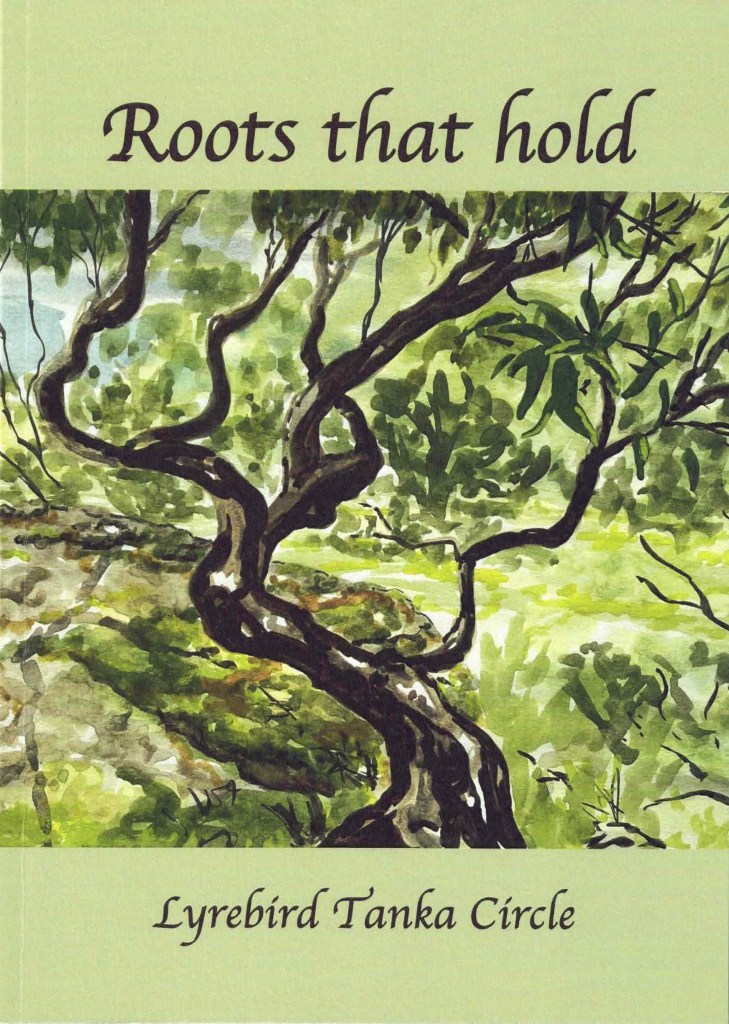
The Circle published its first anthology of tanka prose, Roots that hold, in 2026. The anthology, which was edited by Liz Lanigan, Mira Walker and Tony Steven Williams, presents writing by 14 of the group’s members.
Tanka prose is a literary form that combines prose with one or more tanka. This form, which has been written in Japan for hundreds of years, is growing in popularity among contemporary writers.
In tanka prose, each five-line poem should link with the prose while also shifting the reader’s focus to new events or feelings. In particular, the tanka should do more than simply summarise or repeat the content of the prose.
The following tanka prose, reproduced from Roots that hold, is an excellent example of the form. While the tanka clearly links to the prose, it shifts from events inside the house to past events outside, while also sharpening the emotional spell of the writing. The combination of prose and tanka results in a piece with greater impact than would have been the case for either element on its own – which is exactly how tanka prose should work.
Homestead
Tumbleweed shifts and bounces away from the opening door. Long-settled dust dances
in a shaft of light from grubby windows. Possums have made a home in the fireplace
where once we gathered and told stories of family and place. A matt of cobwebs
obscures the view of overgrown grass and untended roses.
in the garden
before death knocked
water spray
sparkled on icy air
and fell to frozen earth
(Kate King)
The following is the introductory paragraph and tanka from a longer piece of writing (again taken from Roots that hold):
The Road to Riches
Jim has finished his Saturday chores and rides his beaten-up bike along the road
beyond the town. He takes his chores seriously because now he’s the man
of the house. Father is in France, fighting. A canvas satchel hangs on Jim’s back
and inside is a jam sandwich that he made himself. His mother made the jam
from the plums on the tree which shades the verandah.
a pantry
packed with pickles and preserves
throughout the war
her fruit and feelings
all bottled up
(Barbara Curnow)
Tanka prose is not limited to a single paragraph and a single tanka. The Road to Riches actually comprises five paragraphs of prose interspersed with three tanka. As can be seen from the extract above, Barbara uses the prose to tell the tale of a child’s exploits, while each tanka hints at the ever-present wartime worries of the boy’s mother. In this way, Barbara skillfully incorporates both the child’s activities and the mother’s feelings without disrupting the flow of the piece.
The rules of tanka prose are not fixed: writers have the freedom to structure things as they wish. The overall length of a tanka prose, the sequencing of paragraphs and tanka, and the nature of the prose are all flexible.
In Sight
Let the waters settle and you will see the moon and the stars mirrored in your own being. Rumi
ten days of silence at the Vipassana stillness on the outside turmoil within diminishing day by day
until a single breath passes through my body unrestricted and then another oh the peace of being
with other meditators inhaling exhaling we are the nothingness of everything the everlasting
wonder of an ever-changing now
silk lake
reflections scatter
in the rain
I close my eyes
. . . see as it is . . . as it is
(Liz Lanigan)
In this final example from Roots that hold, Liz has first included an epigraph from the poet Rumi, and then written the prose without punctuation. The lack of punctuation was clearly a deliberate choice. As a result, the prose reads like a prose poem with its flowing character drawing the reader more deeply into the subject matter.
The Lyrebird Tanka Circle anthology, Roots that hold, is a wonderful collection for anyone interested in reading or writing tanka prose. As can be seen from the examples above, tanka prose is a great way of integrating events and feelings into a single piece of writing.
If you would like to read more about tanka prose, you can do so here and here (scroll down for articles on tanka prose).
Quail Eggs: A Tanka Journal
The UK-based tanka journal, Quail Eggs, is published online every three months. Founding Editor, Alison Williams, says “quail eggs are small but perfectly formed and contain a surprising richness . . . They are simply delicious little things, just like tanka”. The Quail Eggs journal invites submissions of tanka, and related forms such as kyōka,…


